Seventh is an artist-run gallery operating since 2000. Learn more about us or join our mailing list to stay connected with what’s on, both online and IRL.
01
Jan
2100
01
Jan
00
-
Admin
All That You Change, Changes You is a symposium curated by Seventh Gallery at Library Portal, exploring feminist, relational, and pluriversal practices of world-making. A full day of talks, poetics, performance, workshops and art, opening into an evening of music, sound, food and fire.
The symposium takes these practices as both its subject and its structuring principle. The organisation of the event itself, its form, its sequence, and the relations it makes possible between people are conceived as an enactment of its central proposition: that many forms of knowing the world are not only possible, but necessary. This curatorial position emerges from a pluriversal ethos articulated by decolonial thinkers and given form in the Zapatista phrase "a world where many worlds fit".
Through this symposium we are interested in centring knowledges that are transmitted and informal, somatic, collectively produced, and difficult to attribute. Ways of knowing that are, by nature, resistant to capture, unable to be plagiarised, monetised, or owned. Knowledge that moves through the body and the mind as one, circulating in the aside and the overheard - an always-present emergent potential.
Schedule
Daytime
13:00-13:30 Welcome to Country & Smoking Ceremony
13:30-14:00 Relational Accelerationism is Not a Thing with Dr Rebecca Conroy
14:00-14:45 Ghost Weaving; Past, Present & Future Healing with Dr Paola Balla & Rosie Kalina
15:00-17:00 The Pillars with Genevieve Callaghan & Manisha Anjali
15:00-15:30 Spectrum Voice (Organ Pipes I) with Nick Ashwood
15:30-16:00 Second Reading with Clara Chanisheff
16:00-16:30 Intertextual Readings With an Entheogenic, Ecodelic Garden with Adele Wilkes & Tessa Laird
16:30-17:30 Who can we become? What might it mean to make feminist music with Prudence Rees-Lee
17:30-18:00 Spectrum Voice (Organ Pipes II) with Nick Ashwood
18:00-18:30 The Horse Sanctuary Theory of Fiction with Tina Stefanou, Lisa Salvo & Duré Dara
Eveningtime
19:30-21:30 The Feast (communal Persian dinner) with Ronen Jafari
19:30-21:30 Live sitar music during dinner with Saikat Bhattacharya
21:30-23:30 Wiggly jazz-fusion & broken beat sounds with Poli Pearl
All Day
A curated selection of art, writing & film screenings offered by:
Ivana Lilith, Tina Stefanou, Paola Balla, Adele Wilkes, Holly Goodridge, Karrabing Film Collective, Nick Ashwood, William Bennett
Venue
Library Portal is a self-organised, artist-run project located within the Holy Monastery of Axion Estin in Northcote (formerly the Little Sisters of the Poor Convent). It is an independent library, arts centre, and meeting place, housing a collection of over 10,000 borrowable books that asks questions about who and why we are.
Tickets
Early bird tickets are sold out. Separate daytime, eveningtime and full tickets are available now. The communal feast will cater to dietary requirements, and the cost of dinner is included in the ticket price. There will be a bar where you can purchase drinks separately.
A limited number of free and pay-what-you-can tickets are held for anyone for whom cost is a barrier.
Access
You can find Library Portal opposite 11 Hawthorn Road, Northcote. Enter the grounds of Our Lady Axion Estin, cross the grass, and you’ll see the door.
Northcote Station (Mernda line) is a 5-minute walk (about 260m). The 11 (St Georges Road) stops a 5-minute walk away at Sumner Ave. The 86 (High Street) stops a 7-minute walk away at Arthurton Road. Street parking is available on Hawthorn Road and surrounding streets.
The venue has step-free access and an accessible toilet, and there will be plenty of seating throughout the day. Library Portal is in a beautiful but quirky old building, so if you have specific access needs, please let us know before the event and we'll do our very best to accommodate you.
For any questions, you can email Lucie at lucie@seventhgallery.org.
.png)
29
Aug
2026
29
Aug
26
-
A symposium on feminist, relational, and pluriversal practices of world-making
All That You Change, Changes You
This project takes shape across three consecutive exhibitions, conceived as chapters within a single inquiry into matter, extraction, transformation, and site. Each exhibition approaches these questions differently, yet all are grounded in a shared investigation: what if matter is not inert substrate, but active participant? What if landscapes, infrastructures, roots, minerals, pulp, clay, cables, and wreckage exert forces of their own?
The project draws from contemporary vital materialist thought, particularly the work of Jane Bennett, whose conception of vibrant matter proposes that agency is distributed across human and nonhuman assemblages. Matter does not only receive form. It impedes, exceeds, collaborates. This thinking resonates with earlier philosophies of nature in which matter is understood as duration and spontaneous generation rather than static substance.
At the same time, the project remains attentive to political economy. In dialogue with Joshua Simon’s writing on neomaterialism, the exhibitions consider how materials circulate through regimes of extraction, production, and value. Timber becomes pulp. Pulp becomes paper. Clay becomes surface. Infrastructure becomes spectacle. Submarine cables become invisible architecture. Commodities and ruins alike accumulate historical force.
Across the three exhibitions, material transformation is understood as a structuring force, shaping landscapes, infrastructures, and forms through ongoing processes of extraction, decay, circulation, and renewal.
— Lucie Loy
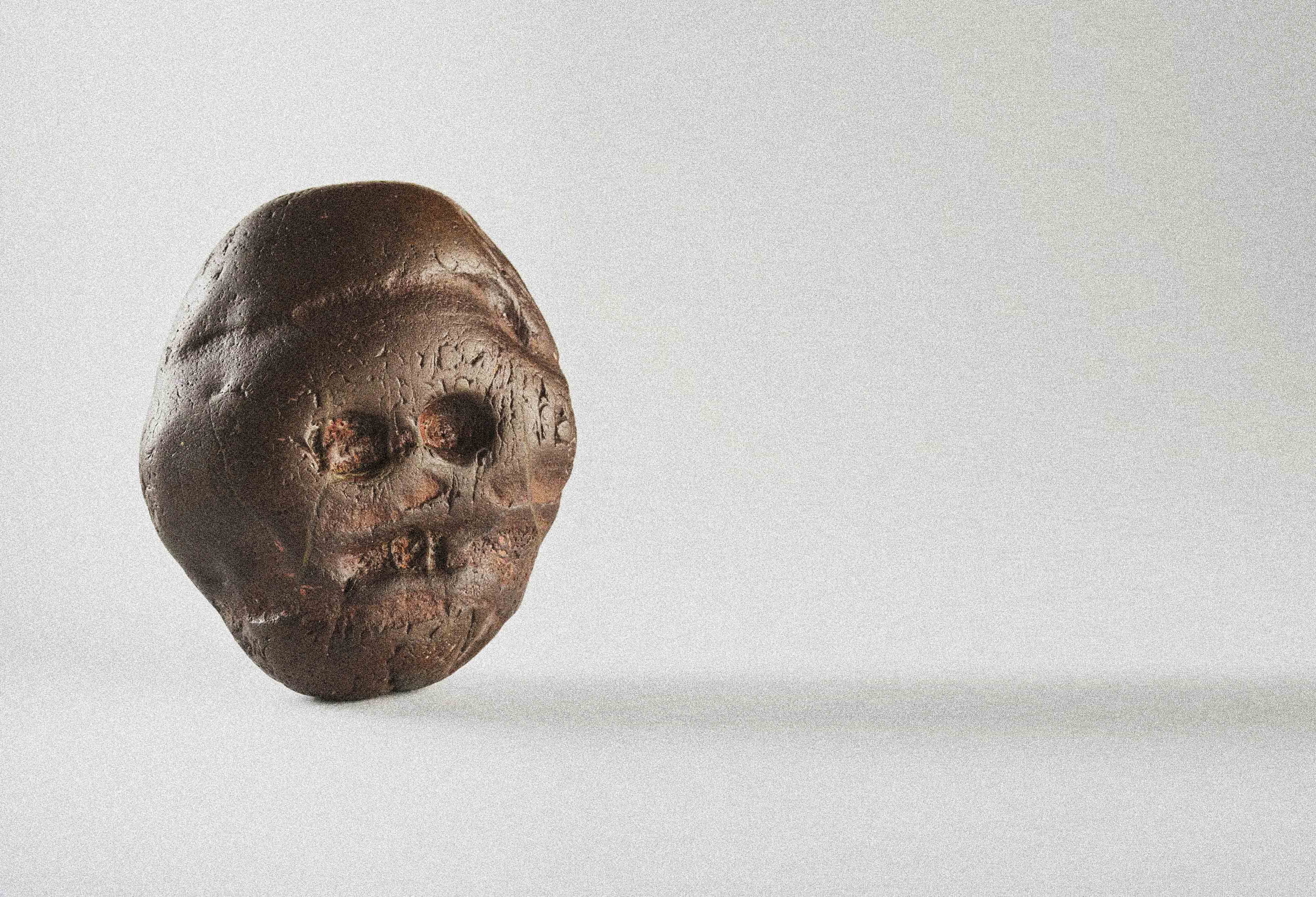
Image | Brett Eloff, University of the Witwatersrand. The Makapansgat cobble, a jasperite pebble excavated in 1925 from the Makapan Valley, South Africa. Its nearest geological source is approximately 32km from where it was found, suggesting it was carried there by an Australopithecus africanus individual between 2 and 3 million years ago, making it one of the oldest known manuports.
A manuport is a natural object whose only transformation is displacement. No extraction, no processing, just a decision by someone to pick something up and move it somewhere else. Because manuports are unmodified, archaeologists have concluded that many must have been chosen for their beauty , making them some of the earliest known recognitions of aesthetic character, and possibly some of the earliest examples of (found) art.
~
Pulp,
Angus Brown
4 March – 18 April
In Pulp, Angus treats the photograph both as an image and as an object shaped by the same material forces it depicts. For this body of work, Angus travelled through the ancestral lands of the Gunditjmara peoples, now known by some as the Green Triangle - a region of south-west Victoria centred around Hamilton and Portland, and the largest wood fibre producing region in Australia. Across approximately 130,000 hectares, Tasmanian blue gum (Eucalyptus globulus) is grown, harvested, and processed on a 10-15 year rotation cycle, valued for its short, high-quality fibres and high pulp yield. At processing facilities near Myamyn and the Port of Portland, woodchip is accumulated, loaded and shipped to China and Japan for use in paper and rayon textile manufacturing.
Angus returned from the region with photographic documentation of vast monocultures, open-air stockpiles and the continuous movement of timber through 24-hour pulping terminals. These landscapes feel engineered and otherworldly, shaped by extraction, repetition and scale. Scrap limbs salvaged from recently flattened plantations have been pulped into sawdust, introduced into the exhibition space as a sculptural element, tangible image surface and paper toning method. The image-based works become inseparable from the resource they depict.
There is something in this that speaks directly to the logic of the Green Triangle itself - raw material extracted from farmland, exported unrefined, transformed elsewhere, and returned in another form. The exhibition stages a version of this same movement (tree to pulp, pulp to paper, paper to image) collapsing the distance between landscape and representation. Matter circulates. This movement is represented in the photographs themselves, and also materially embedded within them.
What emerges is a kind of circular return. The tree becomes pulp, pulp becomes paper, paper becomes image, and the image carries the residue of its origin. There is something quietly alchemical in this shift of states, where matter changes form yet retains a trace of what it has been. The material does not disappear into representation. It persists within it.
~
Strange Powers,
Kym Maxwell, Nicholas Burridge, Leon Rice-Whetton
29 April – 13 June
The second chapter of Matter & Spirit gathers three practices around the network (electrical, mycorrhizal, logistical) as material condition and active force. Where the opening exhibition traced the life cycle of a single resource, this exhibition moves outward. Into contested river systems, industrial dead zones, and the underground life of soil. All three artists are attentive to what Jane Bennett calls thing-power - the capacity of nonhuman matter to impede, exceed, or redirect human intention. But none of the works exist outside of capital either. A river shaped by five thousand years of mining and the British company that industrialised it; a tree felled to service power lines; a portside landscape restructured around the movement of freight. They are also grounded, then, in the political question Joshua Simon poses: who extracts, who profits, and what gets left behind. The works in this exhibition follow matter as it organises itself; across, beneath, and often in spite of the systems imposed on it.
Nicholas Burridge's installation enters the Río Tinto Mining Basin in southwestern Spain, where the river runs red. A network of electrical cables and junction boxes house vignettes of this other worldly place; photographic works printed in the river's hyper-acidic waters, stories of scientists working in the field and a sample from Tasmania, the regions geologic twin. At the core of the work is a question that scientists, corporations, and communities still contest. Is the river's extreme acidity a natural phenomenon, the ancient metabolic signature of subterranean organisms feeding on one of the world's largest sulphide ore deposits? Or is it primarily the consequence of mining, and in particular the industrial devastation that followed 1873, when the British-owned Río Tinto Company Limited took control and scaled extraction? The answer determines everything. What the river is, who is responsible for it, and what, if anything, should be done. Nic does not attempt to resolve this. His work inhabits the contradiction, making visible a matter that is, all at once, geology, microbiology, industrial ruin, and living system.
Kym Maxwell arrives at similar terrain from a different excavation. Following the involuntary removal of an Australian Blackwood (Acacia melanoxylon) to make way for power lines in her garden, Kym turned the act of uprooting into a durational encounter with the mycorrhizal networks below ground. Where the logic of infrastructure saw only an obstacle to be removed, Kym found a dense, interconnected world beneath. A root system more complex and beautiful than anticipated, one that continued to generate new growth from each severed point. The resulting sculptures and drawing carry the weight of this specific loss but also register forces beyond grief. A tree conducts an electrical current through the human body when touched. Soil decomposes and regenerates. Oil transforms under pressure, whether geological or industrial. This last material pulls the work outward. A large drawing traces the ecology and science of the oil industry, moving through one manmade crisis after another, from the exploitation of natural resources to what Kym describes as petro-masculinity. Through what she calls a fem-based petroscape, Kym educates herself on her own terms, unearthing a history of extraction that mirrors the one she began with in her own garden. The drawing is accompanied by a sculptural assemblage. A male form on a plaster table, surrounded by buckets of engine oil, food fat, water, and cooking oils. Materials of modernity and monocultural collapse, sitting together as paradox. Like Nic, Kym is working with matter that refuses to be passive.
Leon Rice-Whetton's video work, you are passing another…, turns to the networks that circulate above ground and on the surface. The work moves across truck routes, port infrastructure, freeway bypasses and the waterways of West Melbourne. Hanging over this all is the ever-stationary Melbourne Star, a $100 million observation wheel that opened two years late, closed after 40 days due to structural failure, took five years to rebuild, never turned a profit, and shut permanently in 2021.(1) The Star promised to transform this landscape into a destination, and to produce spectacle value from a place that otherwise very much resists it. A monument to engineered experience that barely functioned, the Star is perhaps the most literal example of thing-power in the exhibition. An object of spectacle that failed spectacularly but remains as a permanent fixture on the landscape. Drawn to this area through an ongoing preoccupation with the Star, recent infrastructure developments such as the West Gate tunnel and their own experience as a commuter cyclist, Leon looks to the density of competing networks that cross over one another if you stay still long enough to notice. Freight logistics, failed entertainment infrastructure, bird populations, tidal waterways and the occasional pedestrian all present in the same frame. Through methods of extended duration, stretching and stitching footage to subtly dilate time they apply pressure to the habit of passing through. Birdsong cuts across the hum of trucks. Leon directs our attention towards the details, and finds a site that is layered with competing forces, none of them still.
Together, these three artists form a loose but resonant argument. They are dealing with networks that organise matter and life in ways that exceed, predate, or operate indifferently to the human interests that claim to govern them. All three are embedded in the political economy of extraction, and are informed by a vital materialist instinct - that matter is not merely acted upon but acts also.
(1) Though recent news of a completed ‘creditor deal’ has teased the reopening of the star sometime in 2026.
~
Timeball,
Rachel Rovira, Katie Paine
24 June – 15 August
Opening Thursday 25 June
Time girds the earth tight. Day after day, astride minutes and seconds, the hours ride as they must, relentlessly. In the struggle to keep pace with clocks, we are now always and everywhere in a state of jet lag, always catching up with ourselves and with others, slightly short of breath, slightly short of time.
—Raqs Media Collective, "Now and Elsewhere," e-flux journal, no. 12, January 2010.
The third and final chapter of Matter & Spirit brings together Rachel Rovira and Katie Paine, closing the project with two studies of infrastructure and time, situated within this settler colony we call Australia. It's interesting because time itself, how we experience it now, was and remains a colonial technology, standardised and broadcast to order commerce and movement across empire. It's almost impossible to imagine any other way. The exhibition takes its name, Timeball, from something embedded in Katie's research yet curiously absent from the show itself. At Point Gellibrand in Williamstown, a time ball dropped from its tower at precisely one o'clock each day, broadcasting local time so that ships in the harbour could correct their chronometers before heading back out to sea, instruments that were themselves part of a global system of navigation oriented around Greenwich. Rachel's work carries a version of this same impulse, in the regimented schedules of gates opening and closing, irrigation systems triggered by timers, and the daily rhythms of maintenance work that keep a festival site running to time for its public.
In Timeball, Katie's work draws on archival research into Hobson's Bay, tracing how telegraphy, maritime timekeeping and early rail worked to order land, labour and empire, and how these technologies persist by shapeshifting. Their cable routes now carry the fibre optic networks of a new kind of empire. Rachel's work also looks at how landscapes are continually produced through entangled histories of labour, infrastructure, ecology and use. The work she has made for this exhibition emerges from her time on the maintenance crew at a festival in Adelaide over the summer, tracking the rhythms and routines of a temporary site. In Rachel's work, maintenance emerges as an ongoing negotiation with forces that exceed control, where human intention encounters weather, growth, deterioration and the agency of matter itself. Both Katie and Rachel are asking who controls time, who controls place, and what happens when those systems of order and control degrade, or transmute into something else entirely.
~
Images | (1-6) Angus Brown, Pulp. 4 March – 18 April. Seventh Gallery, Collingwood; (7) Leon Rice-Whetton, Kym Maxwell & Nicholas Burridge, Strange Powers. 29 April – 13 June. Seventh Gallery, Collingwood; (8) Kym Maxwell, Acacia Melanoxylon root: removal — a systemic rerouting of understanding (and misunderstanding) of place (magpie, witchetty grub, and clay). Electric soil, cell, soul, 2026. Acacia melanoxylon root, regrowth, soil, mild steel, styrofoam, cardboard, coir husk, PVA, cellulose-based powdered glue, wire, Raku and earthenware clay, 3 x dolley, enamel paint. 4m x 115cms x 2.1m, and Gardening Is not a hobby it’s the only activity where you physically rehearse what happens after death, 2026. Cold-pressed watercolour paper 300gsm, watercolour, acrylic paint, gouache, charcoal, graphite, soft pastel. Size: 215cms x 152cms; (9) Kym Maxwell, Oil’s metamorphosis: A tale of Petro-Masculinity from a fem -Petroscape- perspective, 2026. Cold-pressed watercolour paper 300gsm, watercolour, charcoal, graphite, soft pastel. 230cms x 140cms; (10) Nicholas Burridge, No Pristine Nature, 2026. Environmental analogue installation - Electrical boxes, conduit, electrical fittings, electrical wiring, LCD screen, Arduino, headphones, chalcopyrite rock sample, worm drive motor, DC power supply, copper, circuit board, copper sulphate (analogue), LED strip, dimensions variable; (11) Nicholas Burridge, No Pristine Nature, 2026 (artwork detail) - Interview Excerpt. Single-channel video with sound, 3 minutes 54 seconds, 2025; (12) Nicholas Burridge, No Pristine Nature, 2026 (artwork detail) - Interview Excerpt. Single-channel video with sound, 3 minutes 54 seconds, 2025, and Sulphide Rock Sample, Mount Lyell rock sample, 2026; (13-14) Leon Rice-Whetton, you are passing another..., 2026. Single-channel video, sound, 23 mins.